Posts

Feedback Thoughts

Image
In terms of the feedback I have received in the past and my views on feedback in general, I think the most effective form of feedback is semi-negative (constructive criticism) in written form, followed up by positive reinforcement. Tou gh constructive criticism on paper and encouraging advice in person have been the most effective motivators for me to improve my writing (which is the lens through which I am examining feedback--as an English major, almost all the feedback I receive is on essays). In sports in high school, I was never quite good enough to warrant any sort of scathing negative feedback. Kind of sad, but I was a very mediocre cross country and track runner. All the feedback I received there was positive, both from my coaches and from my peers, and I loved both sports despite my incredible mediocrity. The two articles I chose are: Silence the Critical Voices in Your Head : This article, appearing in the Harvard Business Review , emphasized noticing positive feedb...

Topic Brainstorm

Image
Death Stories : This topic is the first that stood out to me, from the list of potential ideas. I really appreciate books and television shows -- a la Game of Thrones , The 100 , and Battle Royale -- which aren't afraid of killing characters (but only in plot- or character-arc-relevant ways). Other than birth, death is the singular uniting constant in the human experience, and consequently, the most universal theme in literature and life. To write about death is to write about life -- about what it means to be alive, because life is predicated on the looming certainty of death. All that said, I think that looking into ways that ancient Indian culture viewed and dealt with death, especially in their epic poetry, is incredibly interesting. I will also be able to contrast this view with that of the ancient Greeks, whose epics the Iliad and the Odyssey I read in May. Epic Heroes : The second topic that caught my eye is incredibly related to the first. If epic heroes in India...

Week 2 Story: Derwin's Curio Shop

Image
Hidden in an unbreathably narrow alley off Coroner Street and tucked snugly between Unholy Spirits & Liquor and Ink'd Tattoo Pub, Derwin's Curio Shop seemed almost normal. The faded wood paneling and crooked metal lettering on the front of Derwin's retreated behind the bright, blaring neon signs of the boozery and tattoo-bar. Shadows and cigarette smoke and the echoing, uneven slap of feet on cobblestone hung in the air above Derwin's, no matter the time of day. The nondescript, dull exterior belied the exotic interior of Derwin's Curio Shop. Inside the cramped, single-room shop were peacock feathers, astrolabes, dusty hardcovers, a stack of impressionist paintings, East-Asian postcards, long shards of wood recovered from Mediterranean pirate ships, porcelain busts, unopened Cracker Jack boxes, signed baseball cards, Revolutionary War-era muskets, hand-carved statuettes depicting Hindu deities, ancient Chinese manuscripts, and communist propaganda made during...

Reading Notes: Week 2 Anthology

Image
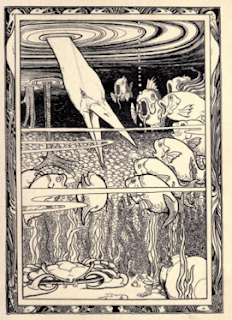
I really liked the story " The Cunning Crane and the Crab ". While I expected the tale to end after the fish were eaten, giving an Aesop-like moral about trusting a self-interested predator or an enemy, the continuation of the story with the Crab -- who is the fulfillment of this previous, potential moral -- is much more satisfying, as the Crab outwits the 'cunning' Crane, giving the Crane the penalty he deserves for his lies to and murder of the fish. This inversion of the expected tropes and ending of a moralistic fable is something I would like to imitate in my writing; I hope that when I write stories, the reader is surprised, at least a little bit, by where the story ends up -- a predictable ending is usually not a marker of a good, well-told story. This is shown through the ending of "The Cunning Crane and the Crab," as I expected the Crab to spare the Crane's life, so as to impart another moral about mercy in the face of a situation that does not...

Week 2 Reading Overview

Image
I chose to read the R. K. Narayan version of the Ramayana because I really prefer to have a physical copy of whatever book I am reading. Also, I am slowly accumulating a personal library, so the more books the better! This book will look great on my shelf! Source . The two comic books I am interested in are: Thanjavur: City of Brihadeeswara This looks interesting since it seems to be about a quest, and it also contains some mythic history about Indian deities. Konark: Temple of the Sun This looks interesting s ince it seems to be about a father and son, and it looks like it includes some coming-of-age themes and a mysterious "supreme sacrifice." The two videos that I am interested in are: Indian and Greek Mythological parallels | EPIFIED This looks interesting because I am studying Classics, and especially the Greeks and their epic tradition and mythology. This looks really cool! Foods for Gods | Epified This looks interesting because the food gods ea...

Time Strategies

Image
I have always bee a procrastinator. A write-my-ten-page-research-paper-the-night-before-it's-due kind of procrastinator. In college, as I've gotten older and started taking heavier and heavier courseloads each semester, I've been forced, out of necessity, to work ahead sometimes. And as well as it works for me, I am still resistant to any sort of working in advance of a due date -- why study when I've got plenty of time that isn't now? One thing that I have discovered, a thing reinforced by one of the articles, is checklist making. On Trello, the article  "How Checklists Train Your Brain To Be More Productive And Goal-Oriented"   by  Lauren Marchese  indicates dopamine and gamification as two pillars for good list-making. First, checking something off a to-do list triggers a release of dopamine -- our brain's happy juice -- and we feel a surge of gratification. In order to motivate ourselves to begin checking things off, however, we can use gamifica...

Technology Overview

Image
The technology options in this class seemed very intimidating at first. Juggling multiple websites (blog, storybook, branching stories) along with multiple other graphic design and informational sites definitely intimidated me. However, after taking a moment to examine the options, the technology options are much less scary. I have kept a blog, created a website, used Canva, and explored other tech opportunities for other classes, so this list is (luckily for me) mostly a list of things I've done before. Also, having taken a Digital Composing class which focused on ease of use through dual-stream reading techniques, I'm hoping to make my online content pretty easy to read or browse.   Hopefully, I can inject some life into my blog posts and other online content for this class. ( Source ) We'll see how it all turns out. I am especially intrigued by the Twine option for creating choose-your-own-adventure branching stories. That's super cool!